
Updated
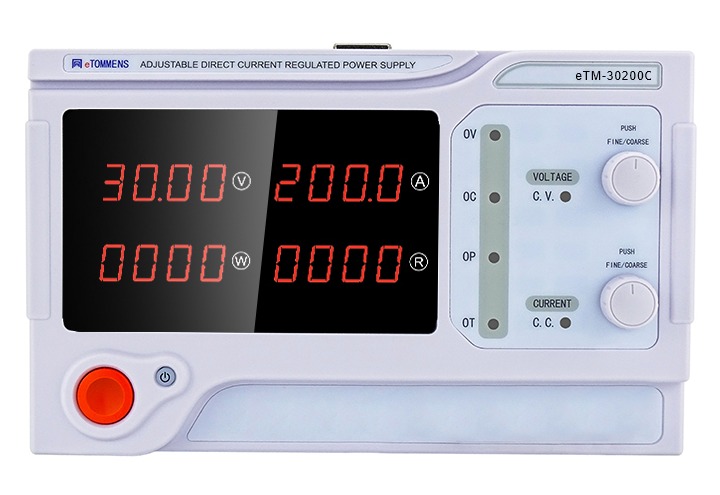
Quick answer: Choose a high-current programmable DC power supply from the load profile, the voltage tolerance at the DUT and the way the supply will be wired. Remote sense can reduce steady-state voltage error caused by power leads, but it does not replace correctly rated cables, connectors or protection settings.
On this page
Define the operating point
The operating point consists of normal voltage, steady-state current, startup current, peak duration, duty cycle and allowed voltage deviation. Calculate nominal power from voltage multiplied by current, then compare it with the model’s continuous rating and cooling requirements. Do not treat a maximum headline current as a continuous rating unless the product documentation states the duty cycle and operating conditions.
Remote sense and cable drop
Remote sense measures voltage at the load instead of only at the supply terminals. It can compensate for voltage drop in suitable high-current or long-lead setups, but it does not remove the current, insulation, connector or stability requirements of the power cables.
Remote-sense performance depends on terminal polarity, compensation range, open-sense protection, cable length, lead routing and the model’s sense-input requirements. A disconnected or floating sense lead can produce a model-specific protection response or an incorrect DUT voltage. The exact manual defines the permitted connection and operating limits.
Protection and transient behaviour
Check current limiting, overvoltage and overcurrent behaviour, short-circuit response, overtemperature protection, output enable and disable behaviour, and fault recovery. For pulsed loads, compare transient response and recovery time under matching test conditions. A high current rating alone does not establish fast transient performance.
Wiring and acceptance checks
Use conductors, terminals, fusing and connectors rated for the expected current and temperature. Before connecting the device under test, verify polarity, current-limit behaviour, remote-sense operation and output-off behaviour at a conservative operating point. Measure voltage at the DUT terminals when the load is running.